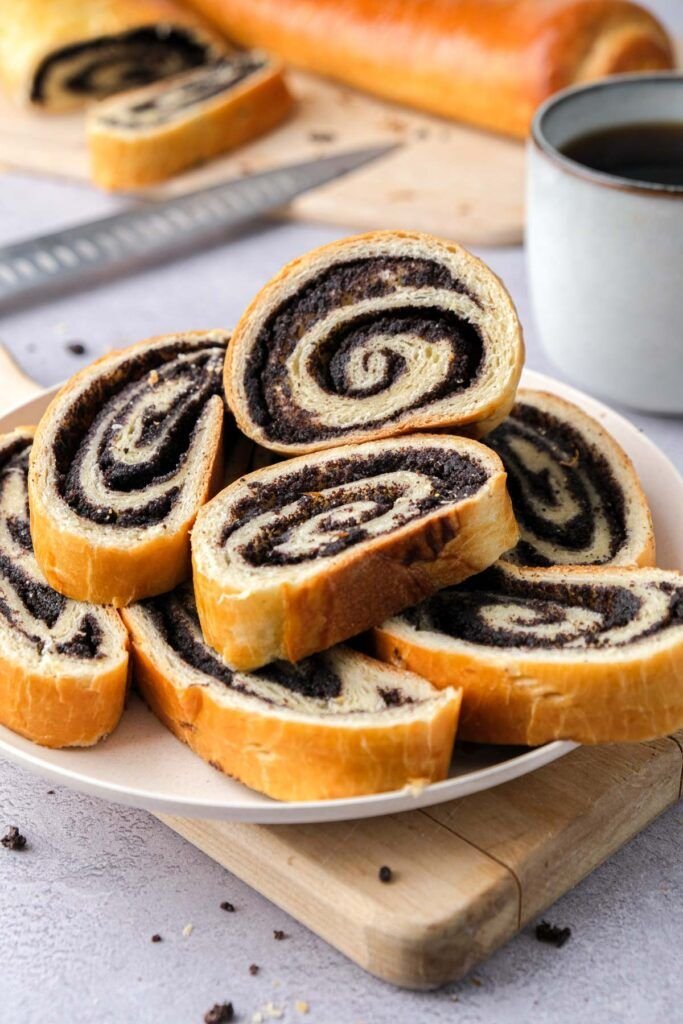
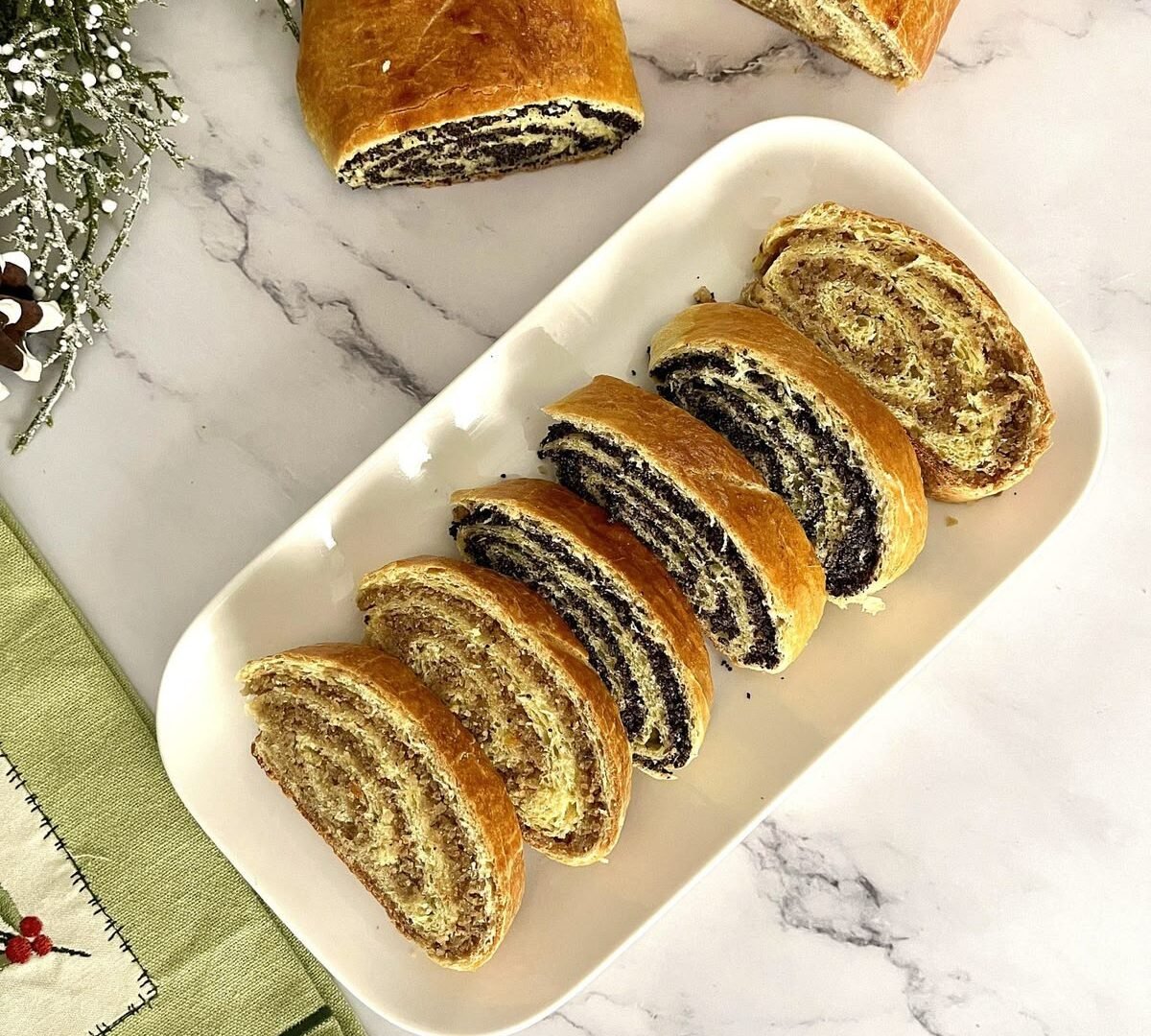
The Hirshon Hungarian Poppy Seed and Walnut Beigli – Mákos És Diós Bejgli
How to Make Hungarian Beigli
1. Prepare the Dough
Warm the milk slightly and combine it with the yeast and tablespoon of sugar.
Let it stand for several minutes until the yeast begins to activate.
In a large bowl, combine the flour, powdered sugar, and salt.
Add the chilled butter and work it into the flour until the mixture resembles coarse crumbs.
Add the egg yolks, vanilla, and yeast mixture.
Mix until a soft dough forms.
Avoid overworking the dough. The finished pastry should have a tender, delicate texture.
2. Chill the Dough
Divide the dough into two equal portions if making one poppy seed roll and one walnut roll.
Shape each portion into a rectangle, wrap, and refrigerate for at least 1 hour.
Chilling makes the dough easier to roll and helps create the characteristic texture of beigli.
Prepare the Poppy Seed Filling
Combine the milk, sugar, honey, and raisins in a saucepan.
Warm gently until the sugar dissolves.
Add the ground poppy seeds, lemon zest, vanilla, and cinnamon.
Stir until the mixture becomes thick and cohesive.
Remove from the heat and allow it to cool completely.
The filling should be spreadable but not runny.
Prepare the Walnut Filling
Prepare the walnut filling in the same way.
Combine the milk, sugar, honey, and raisins in a saucepan.
Add the finely ground walnuts, lemon zest, vanilla, and cinnamon.
Cook gently while stirring until the mixture thickens.
Allow it to cool completely before using.
Assemble the Beigli
1. Roll Out the Dough
Place the chilled dough on a lightly floured work surface.
Roll it into a rectangle approximately ¼ inch thick.
Try to keep the edges relatively straight so the finished roll has an even shape.
2. Spread the Filling
Spread the cooled poppy seed or walnut filling evenly over the dough.
Leave a small border around the edges.
The filling should form a substantial layer without reaching all the way to the edges.
3. Roll the Pastry
Fold the edges slightly inward and carefully roll the pastry into a tight log.
Place it seam-side down on a parchment-lined baking sheet.
Repeat with the second portion of dough.
The Secret to the Classic Beigli Appearance
One of the defining characteristics of traditional beigli is its beautiful cracked or marbled surface.
To encourage this appearance, prick the rolled pastries several times with a fork or skewer.
This allows steam to escape while the pastry bakes.
Brush the rolls with egg yolk and allow them to dry slightly.
Then brush them with egg white.
This two-stage egg wash helps create the characteristic glossy, golden-brown finish.
Baking
Preheat the oven to 350°F (175°C).
Bake the beigli for approximately 30–40 minutes, or until beautifully golden brown.
Keep an eye on the pastry during the final part of baking because the exact time can vary depending on the size of the rolls and the oven.
Allow the beigli to cool completely before slicing.
This is important because the filling needs time to set.
How to Prevent Beigli From Cracking Too Much
A few small cracks are traditionally part of beigli’s appearance, but large splits can usually be avoided.
Don’t make the filling too wet.
Cool the filling before spreading it.
Roll the pastry evenly.
Don’t pack the filling excessively thick.
Prick the finished rolls before baking.
Avoid overbaking.
Let the finished rolls cool before cutting.
How to Slice Beigli
Use a sharp serrated knife and cut the cooled roll into slices approximately ½–¾ inch thick.
The cross-section should reveal beautiful layers of pastry surrounding the poppy seed or walnut filling.
A good beigli has a satisfying balance between pastry and filling rather than having a very thick layer of dough.
Mákos vs. Diós Bejgli
Both traditional versions are delicious, but they have distinct personalities.
Mákos Bejgli has an intense, earthy poppy seed flavor with a slightly bittersweet character that works beautifully with lemon zest and raisins.
Diós Bejgli is richer and nuttier, with a naturally sweet flavor that pairs especially well with cinnamon, vanilla, and citrus.
Many Hungarian families prepare both varieties for Christmas so everyone can choose their favorite.
How to Serve Hungarian Beigli
Beigli is traditionally sliced and served at room temperature.
It is wonderful with:
Hungarian coffee
Black tea
Hot chocolate
Dessert wine
A festive Christmas meal
The pastry is also excellent as an afternoon treat when shared with family and friends.
Storing Beigli
Once completely cooled, wrap the rolls tightly or store them in an airtight container.
Beigli keeps well for several days and can actually develop an even deeper flavor after resting.
For longer storage, the finished rolls can also be frozen and thawed before serving.
A Traditional Hungarian Christmas Favorite
For many Hungarian families, beigli is more than simply a dessert. It is part of the atmosphere of the Christmas season.
The aroma of freshly baked pastry, ground walnuts, poppy seeds, citrus, cinnamon, and vanilla immediately creates a sense of celebration.
Whether you choose Mákos, Diós, or make both, beigli is a beautiful example of Hungary’s rich baking tradition.
Final Thoughts
The Hirshon Hungarian Poppy Seed and Walnut Beigli – Mákos És Diós Bejgli brings together everything that makes Hungarian festive baking so memorable: tender pastry, rich traditional fillings, citrus, warm spices, and a beautiful golden crust.
Slice it thinly, serve it with coffee or tea, and enjoy it as generations of Hungarian families have done during the holidays.
One roll of poppy seed, one roll of walnut—and suddenly the Christmas table feels unmistakably Hungarian. 🇭🇺
To provide the best experiences, we use technologies like cookies to store and/or access device information. Consenting to these technologies will allow us to process data such as browsing behavior or unique IDs on this site. Not consenting or withdrawing consent, may adversely affect certain features and functions.
Functional
Always active
The technical storage or access is strictly necessary for the legitimate purpose of enabling the use of a specific service explicitly requested by the subscriber or user, or for the sole purpose of carrying out the transmission of a communication over an electronic communications network.
Preferences
The technical storage or access is necessary for the legitimate purpose of storing preferences that are not requested by the subscriber or user.
Statistics
The technical storage or access that is used exclusively for statistical purposes.The technical storage or access that is used exclusively for anonymous statistical purposes. Without a subpoena, voluntary compliance on the part of your Internet Service Provider, or additional records from a third party, information stored or retrieved for this purpose alone cannot usually be used to identify you.
Marketing
The technical storage or access is required to create user profiles to send advertising, or to track the user on a website or across several websites for similar marketing purposes.